Showing posts with label school workshops. Show all posts

Thursday, 17 February 2011

Making ‘cents’ of Money Matters

Our new workshop started this week. It’s called ‘Money Matters’ and is very topical when you consider the recent calls for financial education to be made compulsory in schools. Here are a few facts, taken from the Personal Finance Education Group website, that point towards why starting financial education young is important.

•    7 years is the average for children to begin receiving pocket money.
•    8 years is the average age for UK children to get their first mobile phone.
•    10 years is the average age that children begin to purchase items online.

And…

•    Over 75% of 7-11 year olds are already saving for the future.
•    42% of children prefer to store their money in a money box.
•    93% of teachers and parents think that personal finance education should be taught in schools.

So, we think we’re on the right track. As Billy Graham once said: ‘If a person gets his attitude toward money straight, it will help straighten out almost every other area in his life’.

The Money Matters workshop takes place in the Eureka! Bank and our ‘Imagination Space’ room and involves: exploration, investigation, discussions, games and (of course!) role-play. It will hopefully help develop in the children a good attitude towards saving and financial responsibility.

On one particular morning last month, I was dressed very smartly in shirt, tie and jacket with my ‘Bank Manager’ badge hung from my lapel. Enabler Darren was my cashier and also looked the part in another smart shirt, tie and badge. We had great fun in the bank as the children (7-9 years old) filled in withdrawal forms with Darren to get their Eureka! Bank notes and phoned me in my office to ask pertinent questions such as ‘Why should I keep my money in your bank?’ and ‘Is it fun being a bank manager?’
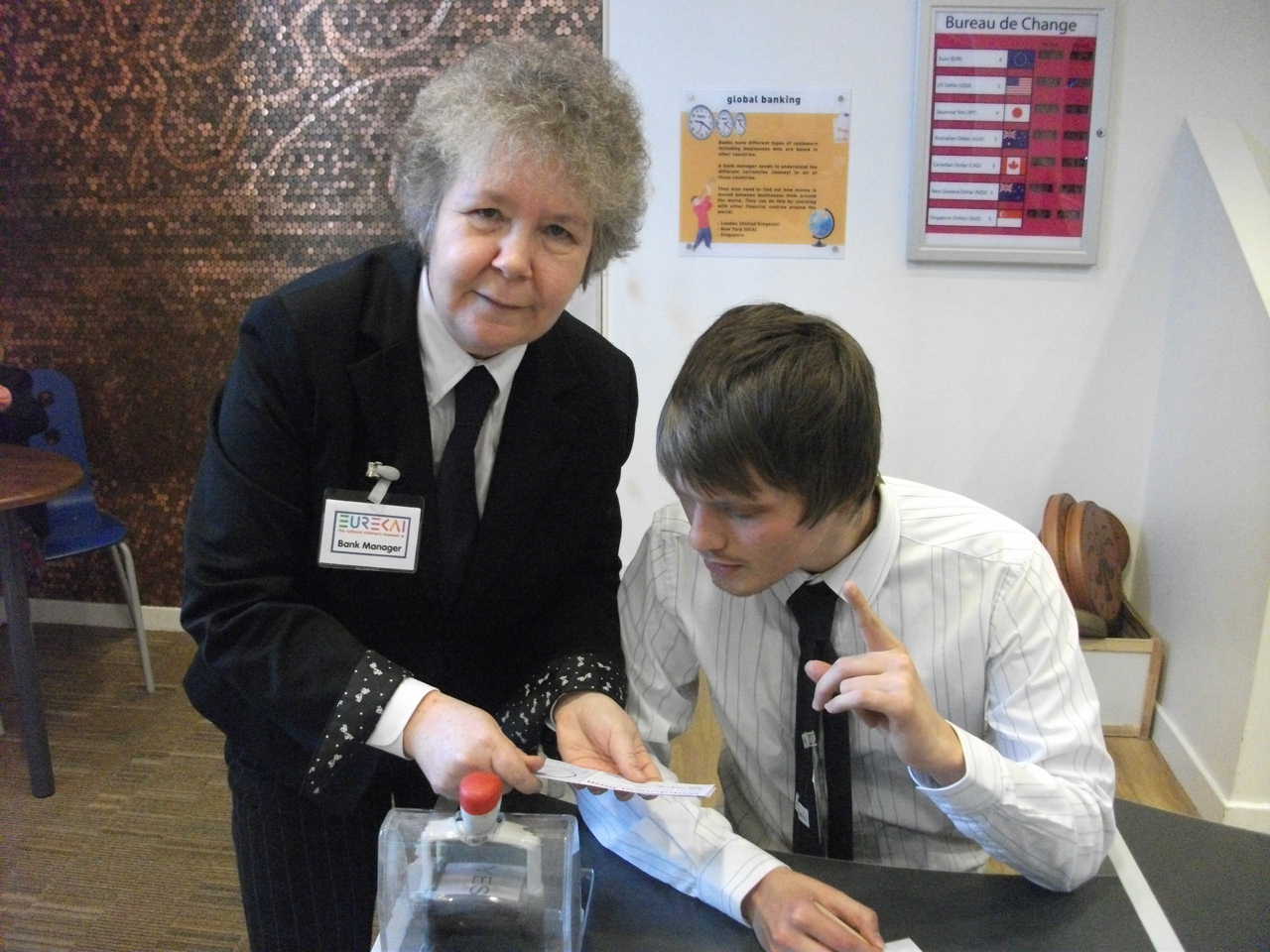
Money matters here in the Eureka! Bank!
They explored the bank vault with its huge thick doors and different alarm systems. They discovered all the security features that make it so difficult to forge a banknote. They even sat in a million pound chair and contemplated what they would do if they had that much money!


Keeping the Bank Vault safe and secure!
Back in the Imagination Space we had the children counting up giant laminated coins, working out interest payments on their calculators and joining in with a game that was a mixture of  ‘Play Your Cards Right’ and ‘The Price is Right’. The children responded brilliantly to the tasks and the discussions. It was heartening to hear their reasons for not spending all their money:
•    “Because you won’t be able to keep your promises if you’ve promised to take somebody on a day out”
•    “Because you won’t be able to buy your mum a birthday present”.

They were also very enthusiastic about giving their money away to charities:
•    “Because it’s good to help other people who are poor”

By the end of the workshop the class had accrued over £400 in Eureka! Banknotes. We sent them home with the task of deciding as a class how they would spend, save and give away that money if it were real. It’s a great way to make sure the lessons of saving and spending wisely continue after their visit to Eureka! and I look forward to hearing from them and finding out what they decide.

Jill Ward is an Enabler at Eureka! The National Children’s Museum. If she received £400 she would:
•    Treat herelf to a couple of DVDs.
•    Treat her family to a nice meal out.
•    Give £50 to Comic Relief (because that’s her favourite charity).
•    Save the rest of it towards her next holiday.

Thursday, 16 September 2010

Playing with science: summer educational shows at Eureka!

With a successful summer just finished, I wanted to write a bit about the educational experiences we’ve provided schools during the summer term. It’s a time you might think is a bit more relaxing as everyone looks forward to the holidays, but here at Eureka! play and learning doesn’t stop. During the summer term, we offer schools the chance to experience science shows as part of an educational visit to the museum. Developed entirely in-house by our Learning Team, science shows are a great way of teaching scientific concepts to a large number of children in a fun and interesting way.
Feeling some forces during a science show.
Over the years we have developed a long list of interactive, drama-based workshops covering all areas of the curriculum, but the science show format with its ‘show and tell’ lecture presentation style marked a new venture for us when we embarked on our first show back in 2007 called ‘Splash!’  Aimed at Key Stages 1 and 2 this show looks at all things water related - where it comes from, some of its properties, fun things you can do with water and the importance of saving it.

Presented by our resident science duo Fizz and Flash, Splash! is a great show for a mixed age audience. Even though early KS1 pupils may not fully understand all of the concepts, they still find it visually stimulating and we’ve even performed the show in small rural schools where the audience age range has been from reception to Year 6! Highlights of the show include making water disappear, a water conservation version of Play Your Cards Right and the giant bubble finale where a lucky member of the audience gets to step into a giant bubble!
Fizz and Flash demonstrating the giant bubble in Town Square.
In 2008 we developed a new show based on forces called ‘Feel the Force’. Aimed at Key Stage 2, this time Fizz and Flash are joined by Ted the astronaut bear and explore the different types of forces, demonstrating what they are and why they are so important.   

Forces can be a difficult topic to teach so this show aims to turn a relatively dull subject into a memorable learning experience with lots of hands-on demonstrations and audience participation.

The latest addition to our science show repertoire was developed in 2009. We wanted to write a show with a human body theme and felt that focusing on the digestive system would give us lots of interesting concepts to explore so we came up with ‘From the Chew to the Poo!’ for Key Stage 2 pupils.

This show follows the fascinating journey of a banana and peanut butter sandwich from the moment it is eaten to the moment it leaves the body as waste. Through a series of interactive activities children find out how saliva in the mouth breaks down food in order for it to be swallowed, how our bodies retain the vitamins and minerals our bodies need and more amusingly how it gets rid of what we don’t need.

This is definitely the yuckiest of our three shows and I’m sure our Enablers didn’t think they’d be making ‘poo’ on a daily basis when they came to work at Eureka! but it’s a topic that most kids find hugely fascinating and we get some fantastic comments and pictures from schools following their visit.

It’s definitely been a challenge writing and developing these three shows but thankfully they’ve all proved to be successful additions to our school’s programme. So much so that they also form part of our Outreach provision where schools can book for our Enablers to come and deliver a show in their school.

We’re developing a totally new show now for 2011 which will have a chemistry theme and probably lots of fizzes and bangs - hopefully though we won’t blow ourselves up in the process!

Jenny Parker is the Play and Learning Coordinator at Eureka! The National Children's Museum.

Wednesday, 3 February 2010

Things you never knew about Eureka!

We're getting ready to celebrate Eureka!'s 18th birthday later this year and are planning a number of exciting events and initiatives throughout 2010, including this month, the introduction of a new style admission ticket offering unlimited family fun for 12 whole months.

So, now seems a good time to share with you some unknown facts about the museum that may surprise you.
  • The word ‘Eureka!’ comes from the phrase coined by Archimedes, an ancient Greek philosopher and mathematician. He famously cried ‘Eureka!’ - meaning 'I’ve got it!' - while making an important scientific discovery as he took a bath. The moment has been re-enacted at Eureka! every half hour since the museum opened, meaning that  Archimedes has now taken a staggering 95,058 baths!
  • Since the museum opened in 1992, Eureka!’s dedicated staff have thrown over 2,000 birthday parties and delivered over 32,000 workshops to school groups.
  • Eureka!’s largest exhibit is…Eureka! itself! The inside of the building and all its working parts were left visible when it was first built, so that children can see exactly how modern buildings are put together.
  • Celebrities who’ve been spotted at Eureka! include Peter Kay, Jane Horrocks, Matthew Kelly, Lenny Henry, 80s Pop Legend Chesney Hawkes, former Prime Minister John Major and a host of soap stars including Emmerdale’s Zoe Tate and Mandy Dingle, and Coronation Street’s Martin Platt.
  • The path to Eureka! is a yellow brick road made up of hundreds of individual yellow bricks, many donated by local construction community Marshalls and the remainder sponsored by individuals and businesses in the local community.
  • The most photographed exhibit in Eureka! is the giant mouth in the Me & My Body gallery. A whole group of children can pose on its tongue at one time!
  • In January 1995, 36 children from Burtonwood County Primary School spent the night in the museum with their teacher and Eureka! staff after becoming snowed in during a class trip.
  • Eureka!’s Our Global Garden gallery introduced the world to the character Gordon the Garden Gnome, voiced by Alan Titchmarsh - who later found fame on CBeebies.
  • Eureka! sits on its very own ‘Discovery Road’, a name chosen by Eureka! staff to reflect the exciting experiences which lay at the end of it.
  • One of Eureka!’s exhibits, a digital world population counter, now stands at an estimated 7.08 BILLION people - meaning more than 25 million people have been born since the museum opened in 1992.
And on a more serious note…….
  • Eureka! is an educational charity so all our work is about making a positive contribution to children’s lives.
  • A 10-member Children’s Advisory Board, ‘Ideas United’ has input into all new galleries and programmes developed by Eureka!. This approach of consulting children who are seen as the ‘real experts’ has generated national interest and has been adopted by many other organisations around the world.
  • Over 100,000 children from disadvantaged communities have been able to experience Eureka! at no cost to themselves or their schools, through funding and initiatives set up by the charity.
  • All children in care visit Eureka! for free and all Calderdale schools visit Eureka! at half price.

Wednesday, 28 October 2009

Children say the funniest things

One of the reasons I so enjoy being part of the workshop team at Eureka! is the sheer entertainment value arising from interacting with a group of young children. You never quite know what to expect and their responses continue to delight and surprise me. Children do, indeed, say the funniest things!

One of my favourite memories is from a ‘treasure’ workshop, which we ran one holiday for families. Once the treasure chest had been found at last and the pirate captain had been revealed as an imposter planning on keeping all the treasure for herself, the question arose as to how this un-pirate should be punished. Forget any preconceptions you may have about the sweet and gentle nature of children; cries of “kill her”, “chop her head off”, “stab her with your cutlass” and several other bloodthirsty suggestions were generally yelled enthusiastically at the first mate – who attempted to guide the children towards the less violent solution of making her walk the plank.

On this particular occasion I asked “what do pirates do to punish naughty people; what do they make them do?” One kind father decided to whisper the answer to his daughter but unfortunately she misheard. No doubt with her eyes fixed on the artificial trees and bushes behind the treasure chest she screamed out triumphantly with great gusto “make her water the plants!”

Now, wouldn’t it be nice if she’d been right? Bluebeard and Blackbeard and the like would have had far fewer deaths on their consciences - and their Busy Lizzies and Begonias would have flourished!

Children can also take questions very literally and supply you with very frank and honest answers. I took part in many ‘space’ workshops as Llij Orak, an alien from the planet Kaygool. In most workshops, at the point where Llij reveals she’s not from this planet and asks the children, “so, what am I?”, the united response of “an alien” is delivered in chorus. In one particularly fondly remembered workshop moment a small boy delivered his reply with great confidence, “a liar!” he suggested helpfully.


Sometimes the children are so keen to be picked to give the answer that they forget to listen. In one workshop I was trying to elicit a response from the children to the question, “what makes the toy truck start moving when I let go of it on the ramp?” Very few hands went up so I decided to give them a clue. “What is it that holds me down on the ground and stops me floating off into space?” There were now a lot more hands in the air so I picked one very eager young man whose hand had been waving enthusiastically from the start. “Wheels!” he cried confidently. I looked down immediately to check but no, I still had feet.

It’s not only workshops that provide examples of childhood comedy. One day I was feeling rather low as I walked into the mini post office and came upon a young boy dressed in his postman’s uniform, dragging a huge postbag full of parcels. “Are you doing a good job today Mr Postman?” I enquired; forcing a cheery smile onto my face. My smile deepened as he replied happily “yes, and then I’m going into there (pointing to the kitchen) to be a cooker”. The world was suddenly a better place as I remembered how lucky I am to work with the funniest people in the world.

Jill Ward is an Enabler in the Front of House team at Eureka!

Wednesday, 14 October 2009

Fast Food Fun

One of the joys of working at Eureka! is delivering our amazing interactive educational workshops. Throughout the year I might find myself taking the children on all manner of incredible adventures; from flying off to the planet Kaygool with aliens (I’m one of them) to sailing aboard the ‘The Black Light’ with pirates (me again) to search for treasure. At the moment we’re concentrating on the very current topic of healthy lifestyles with two workshops; Fast Food Fun for 7-11 year olds and Fruit for Thought for the 5-7 year olds.

Watch a video of the Fast Food Fun workshop


At the end of every ‘Fast Food Fun’ workshop I ask the children two questions. The first question is always “have you enjoyed the workshop?” - A question that is invariably answered with a very enthusiastic “YES!” The second question; or to be more accurate set of three questions, are aimed at finding out if they think they’ve learned anything. A unanimous positive response tells me that all the learning objectives have been achieved; and what’s more, the response from the children is just as enthusiastic when faced with these questions as it was to the first. That’s what it’s all about for me and it’s what I love about Eureka!; play and learning are not put in separate categories, play is learning and learning is fun.

I think ‘Fast Food Fun’ is a brilliant way of putting across the healthy lifestyle message. From the moment the children set eyes on Jogger Jill (my alter ego) in her over the top sports gear; complete with jazzy pink leg warmers and ‘bad hair day’ headband, they know they’re here to have fun. I love to see the excitement on their faces as they compete in teams to pick up the little bags of food energy (beanbags) and balance them on their heads, or dodge the beanbags on their way to the supermarket to pick up something from the carbohydrate, fat or protein food groups. All the games are great fun and most of them are pretty active too so we don’t just talk about the value of exercise, we actually do exercise at the same time! Anybody who doesn’t believe in the learning through play philosophy should come along and watch. In what other situation could you get a whole class of 7-8 year olds sitting, totally engaged as they listen to somebody talking about simple and complex carbohydrates and saturated and unsaturated fats – and what’s more, actually understanding the differences and working out which would be the healthier choice.

Every workshop is different because every group of children is different and that makes them as much fun for me as it is for them. (Maybe next time I blog I’ll include a few examples of ‘children say the funniest things’ and you’ll see what I mean). Until then always remember – “adults don’t stop playing because they get old, they get old because they stop playing” Hopefully, thanks to Eureka!, I’ll never get old!

Jill Ward is an Enabler in the Front of House team at Eureka!