Thursday, 19 August 2010

Who slayed our dragon?

Sharp eyed visitors to Eureka! may have noticed something’s changed this week: our Chinese dragon, who guards the fire exit from Me and My Body has been beheaded!

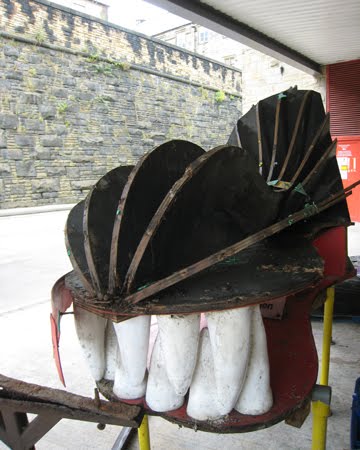
Before you ask, security hasn’t detained any wandering St. Georges. Instead it’s an explanation that’s a bit less magical. He’s quite an old dragon, you see, who has been here since the museum opened. Just over 18 years of weather and wear have taken its toll and early last weekend the metal supports which held him up finally collapsed. His scales were removed and he was taken in state to a new resting place in our Loading Bay, where he is awaiting appraisal. You can see the damaged support below, 18 years of wear on the metal has made it very crumbly.

My what big teeth you have!

Until the dragon’s head returns, I thought I would share some fun facts about him.

  • The dragon was designed to cover the fire escape stairs that lead down from a balcony off of Me and My Body.
  • Our dragon doesn’t actually have a name; as a creature of imagination it’s only fair that we let you, the visitor, make him come alive for yourself.
  • Our dragon has been the inspiration for workshops and events for as long as the museum has been open: he’s seen Chinese lion and dragon dancers and has been the face of our ‘Dragon’s Mouth’ school workshops. 
  • The dragon is now something of a celebrity. Even the Dragon's Den liked the idea of him and filmed him at the end of one of their roadtests. Maybe that's what went to his head!
Dragon & friends back in 1993 for the 'Dragon's Mouth' workshop
But you know, our dragon’s disappearance may have another explanation, especially since Eureka! is such a magical place. Being August, and a rather drought-filled one at that (in spite of weather appearing to the contrary!) it’s important to keep health and safety concerns in mind, especially when dealing with animals known for their flammable nature. So, with a few cosmetic repairs required already, we thought this was the perfect time to schedule our dragon’s annual maintenance for fire breathing capacity. After all, a healthy dragon is a happy dragon, and happy dragons aren’t naughty people-crispers.

Wednesday, 4 August 2010

Playing with a purpose for Playday 2010

Today at Eureka! we are celebrating Playday, the national event where communities around the UK host events that champion and support children’s right to play. In the process of preparing for our events, I read the research released this week by Play England to support the 2010 Playday campaign.

Taking time out for some sandcastle building during last year's Playday!

Play England found there is a profound loss of community spirit in Britain, which in turn is leading to children no longer being able to play outside. I have to wonder what has led to this lack of togetherness, and is it really the only reason why children don’t play outdoors any more?

In 2005 I returned to the UK after four years of living and working abroad. Bringing a six-year-old and a one-year-old back to the UK I became acutely aware of the lack of children on our streets. I noticed the ever-growing perception that children are ‘in danger’ if out of the sight of a parent, and we experienced the lack of play provision in many areas.

As I have written before, the evidence to support our multiple fears is not there. There have not been increases in child abductions and murders, compared to 20 or 30 years back, but there has been an increase in media coverage.

Playday 2010’s campaign theme is ‘Our Place’. Play England’s research states almost half of adults surveyed think it’s unsafe for children to play without supervision. However when 73% of children want to play outside more where they live, isn’t it our role as adults to enable this play in our home environments rather than install fear? I believe it is up to us to take note of these facts and figures, and to support the reinvigoration of community spirit by positively reinforcing the value of play.

It’s also encouraging to learn that the new ministerial Childhood and Families Task Force, chaired by the Prime Minister, has made Playful communities one of its priority areas – this is great news and I look forward to reading their conclusions, which are expected at the end of the year.

Taking time out to play today is just one in a series of steps to change our communities for the better. For Playday, I will be around the museum getting messy, crafty and active. We’re celebrating the right of all children to play, will you?

Rebecca Johnson is Play and Learning Director for Eureka! The National Children's Museum.

Friday, 9 July 2010

Archie's First Bath

Eureka! is turning 18 on 9 July 2010, and through the year we've been celebrating around the museum with our visitors, and revisiting memories behind-the-scenes.

The official opening of Eureka! was set to be a very exciting event, with all the supporters and members of the public ready to come through, and HRH Prince Charles, who had been key to getting the museum located in Halifax, arriving here just to open our doors. It was down to the wire though, with several of us Technicians staying well into the night putting the finishing touches on the paint job in ‘Me and My Body’.

It was all the extra security that gives me my strongest memory of the day. It started the night before when the museum was closed down so that the Prince’s security guards could do a full sweep. Closed down, except for us still painting in the galleries that is! They had dogs come through and sniff for explosives. The dogs were very thorough, one dog popped his nose in my paint can, but they didn’t find anything unless you count a snout full of paint.

I had one of the most important jobs on opening day: standing on the balcony, I watched for when the museum’s designer gestured up at the sculpture of Archimedes in his bath. As soon as all the guests looked up, I had to press a button from the balcony to give Archie (as he’s affectionately known here) his first bath.

As you might know, Archimedes is an important figure for Eureka!. He’s where we get our name, in fact. He’s set to a clock to take a bath every half hour during museum opening times, and he’s been doing so since 9 July 1992, give or take a few days off around Christmas. We hadn’t yet set him to the clock on opening day though, since we wanted to coordinate our inaugural show.

 Archie arriving at Eureka! 18 years ago.

Everything went without a hitch, and the moment for the grand descent came. The designer pointed upwards, the crowd’s eyes followed, and I’m interrupted by a firm tap on the shoulder as one of Prince Charles’ bodyguards steps behind me, thinking perhaps that I’m there ready to detonate a bomb instead!

We showed him pretty quickly that it wasn’t the case; the only harm to anyone might be if Archie displaced a little too much water, and just as quick we lowered Archimedes into his bath and opened Eureka! for an entire generation of children to enjoy.

18 years and still cool as a cucumber!

‘Bazza’ Barraclough is a Technician at Eureka!. He has worked at Eureka! from before its opening and looks forward to receiving his gold watch soon!

Friday, 18 June 2010

Fire and children's play: a discussion

Last week at Eureka! we hosted Yorkshire Play’s open meeting discussing ‘Playing with Fire’, after their DVD of the same name. We had an exciting programme of events, which included viewing the DVD, watching children from the Eureka! Nursery take part in a fire-based play activity and participated in a discussion about the risks and benefits of using fire as a part of children’s play.

Fire is a controversial subject. At the meeting it was agreed by all that making fires is a deep-seated need for many children. But it’s not clear what the best way is to fill that need while also balancing safety concerns for children and the people around them.

I believe that the best thing is to channel that need through exposure to the pleasures and risks of fire in a controlled manner, which is done in many play settings and uniform groups, enabling us to educate children about fire in an age-appropriate way.

We were lucky enough to have a break in the rain so that a group of children from the Nursery could demonstrate just how fire can be used in a play setting. Outside the museum, we watched as the children and Cindy, a PlayScape facilitator did a risk assessment of the area to make sure it was free of sticks and brush which could be set alight. They placed sand and stones to make a boundary that they all agreed not to step over unless they were invited, and they talked about being burned and what to do in case of an accident. Then, they were able to make a fire and cook marshmallows and toast; the only hiccups were when one of the children didn’t like bread!

Making toast over a campfire.

Clare Dean, Eureka! Nursery Early Years Professional, said the children got a good sense of the safety issues as well as seeing that fire can be fun, useful and not just dangerous.

We then spent an hour discussing some of the controversial issues surrounding fireplay, utilising the expert panel. The panel included a member of the Fire and Rescue Service, a child who engages in fireplay and practitioners/trainers who promote fire play. The differing viewpoints and the response from the audience has caused me to reflect. As a parent and a playful learning professional I am often torn about fire play, and in fact, many types of activities that we now consider to contain risk.

Research indicates that parents today are much more fearful and protective than they were 30 or 40 years ago. I want to let my children have the same freedom I experienced but I can’t help but worry. I know there is no evidence to support our fears, there are no increases in child abduction or child murders just more media coverage, and in fact there has been a 75% reduction of children killed on the roads between 1976 and 2006. Peter Cornell from RoSPA stated: 'We need to ask whether it is better for a child to break a wrist falling out of a tree, or to get a repetitive strain wrist injury at a young age from using a computer or video games console'.

When children spend time connecting with nature, getting dirty, getting cut by thorns, building fires they are learning important lessons for life and gaining a stong sense of safety outdoors. It is this knowledge that influenced my decision to be procative in providing experinces for my own children and their friends, I’m lucky enough to have a fire pit in my garden where I regulalry have groups of up to 10 children building and cooking on fires. They now have a clear understanding of the risks asssociated with fire, they have knowledge of what to use as kindling, what and when to add to make a good fire to cook on and the importance of using fallen wood so as not to interfere with the eco system. They also know not to leave the food on too long or else it get burned! When I see the kids in the school playground they always want to know when they can come again or recall stories from the evening before. I hope that, as well as the lessons learned, these are memories for life.

As a panel member, Kofi Johnson, 10 years old, was able to voice how important experience was for his learning and development. He said that he learns more about the health and safety aspects, and risks of using fire by doing and seeing, rather than being told.

The panel discussion touched on many different aspects of using fire in play, and sparked an active back and forth in the audience on topics such as:

•    Why does it appear to be more acceptable for uniform groups to use fire than it is for the play sector?

•    Is it the terminology we use in the play sector that influences people’s perspectives?

•    How do we encourage teachers to see the benefits of fireplay in schools?

We also learned some interesting facts about fire and its societal implications, which raised their own questions.

Peter Lamb, Hull City Council, reported that since the introduction of designated social gateway centres, places where fires are lit and youth and young people are allowed to gather around them, there has been a reduction in vandalism to play equipment.

Gayle Elvidge from West Yorkshire Fire and Rescue Service commented that the number of deliberately set fires they are called out to are reducing year on year. Do you think this could be because more children are exposed to structured sessions? 

It was a constructive session but many of the questions remain unanswered; we’d love to hear your point of view and look out for footage and audio of the debate online soon.

Rebecca Johnson is the Director of Play and Learning at Eureka!
Tuesday, 8 June 2010

Searching for a story (Part III)

This is the last in our three-part storybook trail around the Eureka! galleries. You can also read Part I or Part II.

When Puffin Books released its handbook of the 70 best books for children, to celebrate their 70th anniversary of publishing children’s books this year, we were all excited in the Play and Learning department to see if our favourites had made it in. While I was looking through the list for The Tiger Who Came for Tea by Judith Kerr, I couldn’t believe how many different places at Eureka! reflected the different books.

With that in mind I’ve come up with a small trail that you can use to continue your learning after a visit to Eureka!—or use to get ready for a trip through the galleries!

This week we’re following the trail through Living and Working Together.


The Jolly Postman is by Janet and Allan Ahlberg. He follows his route through the neighbourhood, delivering the letters to all manner of fantastic fairy tale characters. Would you like to be a jolly postman? You’ll have to put on your post delivery clothes, and collect your packages from the post office. Once you’re ready there are so many places and people around the gallery waiting for their post!


Lauren Child’s retelling of The Princess and the Pea is our final place on the trail, and what better way to end a long day than in a nice comfy bedroom. Count the mattresses, are they enough for a picky princess? Do you think you could feel a single pea

To find out more (and download the list so you can read all of these books for yourself), visit Happy Birthday Puffin!

Jenny Goodall is the Bookings Administrator at Eureka!

Thursday, 3 June 2010

Searching for a story (Part II)

This is the second in our three-part storybook trail around the Eureka! galleries. Part I is available here.

When Puffin Books released its handbook of the 70 best books for children, to celebrate their 70th anniversary of publishing children’s books this year, we were all excited in the Play and Learning department to see if our favourites had made it in. While I was looking through the list for The Tiger Who Came for Tea by Judith Kerr, I couldn’t believe how many different places at Eureka! reflected the different books.

With that in mind I’ve come up with a small trail that you can use to continue your learning after a visit to Eureka!—or use to get ready for a trip through the galleries!

This week we’re following the trail through Our Global Garden and SoundGarden. We'll start in Our Global Garden where there are two whole floors to explore!

Polar Bear, Polar Bear, What Do You Hear? is by Bill Martin Jr. and illustrated by Eric Carl, a famous children’s author in his own right. Martin and Carl’s polar bear hears all sorts of sounds during his day. Our polar bear is named Nanuq. Can you find him?

Lauren Child’s Charlie and Lola series makes another appearance with Look After Your Planet. The book is all about recycling, one of the simplest ways that we can all make a difference in taking care of our world. Wander through the gallery, can you find a recycling centre?

SoundGarden is one of our special galleries for under-fives where they can discover and learn at their own pace in a vivid and warm environment.

The Very Hungry Caterpillar by Eric Carl is a classic book that introduces younger children to the world of reading in much the same way through its gentle and vibrant illustrations. In SoundGarden it’s easy to experience life from a caterpillar’s point of view. Look around and find the butterflies, there's even one you can paint! If you were a very hungry caterpillar, what kind of butterfly would you be when you grew up?

Next time I’ll finish the trail with Living and Working Together, but don't forget you can still read Part I!

To find out more (and download the list so you can read all of these books for yourself), visit Happy Birthday Puffin!.

Jenny Goodall is the Bookings Administrator at Eureka!

Friday, 28 May 2010

Weigh anchor and hoist the mizzen

This weekend kicks off our half-term Pirates Ahoy adventure. We’ve put together a whole slew of high-seas hijinks for our visitors; Pirate Training School with sing-along sea shanteys, a treasure map through the galleries and my favourite, a galleon play structure that will be ‘run aground’ outside on the Eureka! Beach for the young buccaneers to explore.

Of course, before we can set sail, we need to hoist the sails. At Eureka! that’s where our team of Technicians come in. While here in Marketing, or in Learning and Education, we’re great about coming up with the ideas and programming that makes a visit to Eureka! magical, without our ‘techies’ keeping the museum at ship-shape, we’d be lost.

And the galleon was no exception. Here’s a sneak peek while we do our health and safety checks and get it ready to set sail in the wild, wild world.

In the Loading Bay 'dockyards'.

The jolly boat ‘Eureka!’ ready for her maiden voyage.

Without our 'techies', we might have had to settle for something less ambitious!

Allison Tara Sundaram is the Marketing and PR Officer for Eureka! Her pirate name is Red Mary Bonney (what’s yours?).