Showing posts with label early years. Show all posts

Sunday, 18 December 2011

Kidspace Children’s Museum, California.


Kidspace children's museum in California
Kidspace is a children’s museum in Pasadena, California. Its aims and goals are very similar to Eureka!'s as it is structured around a learning through play philosophy, and aims to “inspire learning through self-directed, interactive experiences and play in the arts, sciences and humanities that enrich children, families and the community”. 

I was in the USA recently with Rebecca, one of the other Enablers here at Eureka!, and decided to go and pay the people at Kidspace a little visit. Children’s museums are extremely popular in America, with at least twenty-nine of them in California alone so, no matter where we were, we would have had no problem in finding one, but it just so happened that Kidspace was only a fifteen minute drive from where we were staying. We rang up, explained that we were members of the Eureka! team, and were invited for a tour around the museum. Awesome.

Kidspace caters for children aged 0 to 9 years old and, although Kidspace is a lot smaller than Eureka!, there is still a lot for children to do. We didn’t get a chance to play on all of the exhibits, but even with our time limitations it took us a good two hours to make our way around the five galleries .

The Kidspace galleries are:
The Early Childhood Learning Centre
  • EarlyChildhood Learning Centre – A gallery where children aged  0-4 years can play, dance, sing, read at their own pace, and where child-adult interaction is encouraged.
  • Central Courtyard – One of the few places in the museum where parents are allowed to sit and relax, the courtyard offers children water fountains and an outdoor dig-it build-it area.
  • The Digging Deeper Gallery – As one of the main galleries, Digging Deeper offers children the chance to get up close and explore nature. Digging Deeper also has real insects on show, fossils to unearth (see the video on the right!), and an amazing Nature Exchange (which I’ll talk about later).
  • Wisteria Courtyard – An actual child-sized road for children to peddle trikes around whilst learning the meaning of everyday road symbols.
  • The Gardens – The gardens has a lot to offer. Vegetable gardens, a climbing wall, waterwheel and water cycle exhibit. All the different plants offer a huge range of colours and smells, and the winding paths make everything feel that little bit more magical.
Bugsy's Diner in Digging Deeper
Just like Eureka!, Kidspace uses its surrounding environment to its advantage. Being situated at the foot of the Pasadena hills, and in the grounds of the Arroyo Seco Park, Kidspace is surrounded by lots and lots of nature. There is a giant park at the front and a giant forest to the rear and, because of this, a lot of the exhibits are designed around nature. The main gallery, Digging Deeper, offers a lot in the way of this. We were able to come face-to-face with scorpions, a baby goliath spider (which absolutely terrified me), and even bumble bees. We even got to watch a show all about how bees communicate through different ‘dances’, which were re-enacted by one of the Educators, who are similar to our Enablers here at Eureka!

The Nature Exchange
One thing I must talk about though is the Nature Exchange. As a way of getting children engaged with the world around them, and as an introduction to trading, collecting and making observations I thought that this was brill. Children are encouraged to learn while exploring, so if the children discover anything they find particularly interesting they can either collect it, or make a note of it by drawing a picture or writing a description. The children can take their findings to one of the Educators at the Nature Exchange, who will award the child points for their discovery. Over time the child can accumulate points which they can then trade in at the Nature Exchange for ‘nature based’ rewards - things like small shells for a few points, and large pine cones for a lot of points. Not only this, but the children are encouraged to keep making discoveries  away from Kidspace, which they then bring with them when they return, so in this way the learning never stops. I really did like this a lot.

Some of the items traded in at the Nature Exchange

There is so much to talk about that I can’t possibly fit it all into one post, but you can always visit the Kidspace website if you want to have a closer look at what they offer.

Eureka! and Kidspace are both children’s museums, and they both offer a learning experience for children that is built around play and discovery, however they are both very different in how they offer this. I think it has a lot to do with the environment in which the museum is set. Anyway, that’s just a little bit about our trip to Kidspace Children’s Museum in Pasadena, California. It’s really awesome and we had a brilliant morning there, so if you’re ever in the area you should check it out.

Benjamin Guilfoyle
Early Years Enabler 

Thursday, 10 March 2011

Over the rainbow with Early Years activities

Half terms at Eureka! are fantastically themed filled events and this latest one was no exception. Our theme for this particular February half term was the classic film ‘The Wizard of Oz’; the influence of which resonated throughout the full museum. As the Early Years enabler it was my job to make sure that this was also key feature of the under-fives’ area, the Creativity Space. So when it came to deciding on what aspect of the Wizard of Oz to concentrate on I began by breaking the story down to its basic components and found the amazing array of colour featured within. I found that I was also fascinated by the colour used in the film and how they highlighted this burst of colour by beginning with black and white film and then over the rainbow to the wonderfully highlighted, technicolour Land of Oz.

Ready for rainbows in the classroom, as one of our Enablers plays with the light box.
As an Early Year professional I know that colour is greatly important early on in the Early Years Foundation Stage and that, by the age of 3, some children will be able to identify and match up colours. Researchers have found that toddlers are able to learn the names of colours but not an understanding of the relationship between the colours. By the time children are three years old they have mastered the basic colours and correlations between them. However, at this age colourations, shades and neighbouring colours are often still confusing and mistakes are easily made. As learning about colours can be lots of fun I took this as a fantastic opportunity to enhance the opportunities for learning about colours at Eureka! and to express the importance of colour with our ‘over the rainbow’ focus.

Whether we realise it or not colour plays such an integral part of our lives. As babies we begin to associate colours to moods and feelings and throughout our childhood we build upon this. Pink is often associated with a comforting feeling as this is the colour we might have experienced whilst in the womb. Even when we grow older we can attribute other emotional connotations to colours.

Colour is everywhere; all around us this magnificent planet contains all the colours of the rainbow. When we break colour down into it’s simplest form colour is simply light interacting with receptors in our eyes to ‘show’ us the primary colour spectrum: red, orange, yellow, green, blue, indigo and violet; the true rainbow. For The Wizard of Oz our little ‘munchkins’ experienced a different colour each day of the week in accordance to this true rainbow. Within the classroom there was colour everywhere! The light box had coloured sand. The . water tray held coloured gooey ‘Gelli baff’, which is a product that turns children’s bath water into jelly like goo and then back again. The children could paper mache a section of the rainbow, and were also able to choose from an array of materials to create their own masterpieces; all of these were changed daily in accordance with the colour of the day. Along with each colour of the day I also featured their shades of colours, such as light and dark and pastel and vivid colours in order to highlight that each colour is not singular but has an array of variations across the colour wheel.  

It was fantastic to see the children respond in such a positive way to this theme and to the colours within the Creativity Space. I even noticed the impact of some colour days over others; ;on the red and yellow days where people seemed more vivacious than on the more subdued green and blue days. Whatever the reasons for this we all had a wonderful time; this was a well received event and I loved every minute of the week.

During the week, I particularly enjoyed the day where I worked with my favourite colour, blue. What’s your favourite colour? What do you like about it?

Penny Dargan-Makin is the Early Years Specialist Enabler at Eureka! The National Children’s Museum.

Thursday, 10 February 2011

Hello Halicat!

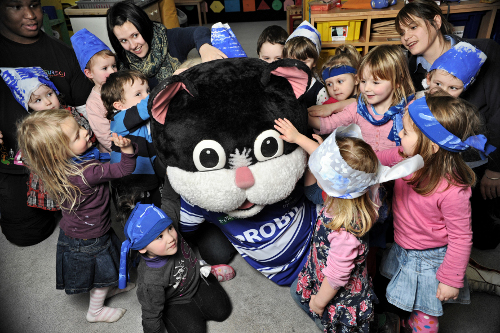
At the Eureka! Nursery last week there were lots of excited children in our pre-school waiting for a very special visitor: Halicat!

A little background, since the mascot from the Halifax Rugby League Football Club doesn’t stop by Eureka! every day. Following the lead from the children’s interest in colours the nursery’s preschoolers have been choosing a colour a week. We have been encouraging the children to bring in objects from home for their show and tell sessions. Last week was blue, and one of the children, Alex, decided he wanted to bring Halicat, who wears a blue and white striped shirt. Alex’s mum works at the Halifax RLFC, and between her office and our nursery we knew there was no question: how could we not make it happen?

Alex brought many Halifax RL artifacts during the week, leading up to the main event and on the Friday morning it was announced that Halicat was coming. We discussed it with the children to prepare them for the visitor. The children were excited, but also concerned about how Halicat would be able to come into the nursery and be safe. Together we all carried out a risk assessment for Halicat. The questions included:
  • How will he know where he’s going?
  • Will he get wet in the rain?
  • If he is so big, what if he doesn’t fit through the door?
We went through all of their questions and assured them that everything would be just right for Halicat’s visit. Just in case, one of the children, Oliver, decided to make sure that a big umbrella was ready at the door for Sandra, our Head of Nursery, to carry out to Halicat if it started raining.

Although the children knew Halicat would come after their dinners they were continuously checking my watch to see if the little hand was at one and the big hand at six. Sam asked me if they could use key worker group time to make presents for Halicat. I thought this was a fantastic idea because it would help them develop colour awareness and give the children ownership of the project. The children wanted to make blue and white scarves, headbands and bracelets, using their colour awareness effectively as they made links between their artworks and the Halifax rugby team’s colours. Everyone had a different way of making their decorations; some made white and blue stripes with rollers, some did finger printing, hand printing, there were so many excellent techniques to try that before we knew it, their dinner was ready.

The dinner period turned into a conversation about what Halicat might eat. Lucas thought chips and Sam thought cat food. After lunch, we sat down on the carpet. The children had put on their scarves and garments; at this point they were so proud of what they had made, they were no longer presents for Halicat, but something for them to show to him what they had achieved. When the security buzzer rang at the Nursery’s front door, Oliver made sure I carried out the safety checks, and all of the children were jumping with excitement.

Children playing with Halicat
It was funny how quiet and nervous the room become when Halicat walked in, but the shy silence was quickly broken by Lucas, who asked ‘Are you Halicat?’, and Halicat nodded.

The questions came on strong after that, and from Alex’s mum they learned that Halicat lives in Shay Stadium, and comes out when the rugby team are playing. This was a good cue for us to encourage the children to communicate about their experiences and family members. Thea said her dad plays rugby, Oliver said his dad was ‘really strong’ and Sam told us he had been downloading photos of Halicat to his dad’s mobile phone!
Halicat prompted another positive learning experience for Ruby. She asked if she could bring out her cat, a very special toy who goes everywhere with her. Ruby came back with her cat and explained confidently to Halicat and the entire group why her cat is different and the same. She told us about the differences in colour; hers is pink, but they both have black whiskers. She identified the size difference, and that Halicat had on big boots and her cat did not.

After a lot of discussion and cuddles, Halicat gave hi-fives to everyone and they all posed for a photo. He even did a little dance before returning home to Shay Stadium.

Posing for the camera.
 The fun, holistic learning experience is still ongoing. The children have regularly revisited their photos of Halicat, and dress up with the different accessories they made. I often hear interesting conversation too as they play together, ‘put your scarf on, it’s rugby today’. What used to be a Chinese dragon has now been made into a ‘Hali-dragon’ by wrapping blue and white material around its head, on suggestion from the preschoolers.

Some children are now saying they will visit Halicat regularly on match days, which is exciting because it could be a new experience for the whole family. For those who aren’t going their not missing out, as Alex will give a regular update for us all. As he said: ‘I see him on Sundays, he’s my best friend!’

Clare Dean is an Early Years Professional at the Eureka! Nursery

Friday, 1 October 2010

The Adventures of Captain Wheelio Bear

Taking inspiration from the CBeebies show ‘Barnaby Bear’ several members of the Eureka! Enabler team created Eureka’s own version: ‘Captain Wheelio-Bear’. Wheelio is a small bear on wheels usually found in the Creativity Space Classroom; that is, when he’s not jet-setting off around the world of course!

Members of the Eureka! team take Wheelio with them whenever they go off on their own adventures, whether they’re gone long for a holiday or just taking Wheelio with them for a fun day out.

In the year that Wheelio has spent here at Eureka! he has: visited Snowdonia, Prague (where he wheeled across Charles Bridge), spent a  Christmas at home with one of our Enablers, celebrated New Year’s 2009 in Disneyland Paris, taken a cruise from New York to Canada, and just this month he came back from a second American cruise. He is certainly a well travelled bear!

Wheelio Bear in Times Square!
In the Creativity Space Classroom at Eureka! he even has his own wall display called ‘The Adventures of Wheelio-Bear’, which shows our visitors all of Wheelio’s worldly adventures and some of his thoughts on where he has been.

This little bear has definitely captured the hearts of the Eureka! team, many of whom can be seen walking around the museum wheeling Wheelio behind them! He has also become a hit with many of our visitors, who often share in a cuddle with him whilst visiting in the Creativity Space.

Next time you’re visiting us at Eureka! please let us know if you’ve been out and seen Wheelio Bear. Here at the museum we love to hear about his adventures.


Penny Dargan is the Early Years Specialist Enabler at Eureka!

Tuesday, 27 April 2010

Bringing Reggio Emelia to Eureka! Early Years

Eureka! is hosting Early Years Week from Tuesday 11 May to Friday 14 May. More information can be found on our Early Years section of the website.

As the Early Years Specialist Enabler at Eureka! I am always looking for new ways to strengthen our Early Years offerings in the nursery and museum.  Last May, I experienced one of the big benefits of my position, when I had an amazing opportunity to visit and share our best practices with a bilingual school in Monza, Italy: ‘Play English’.


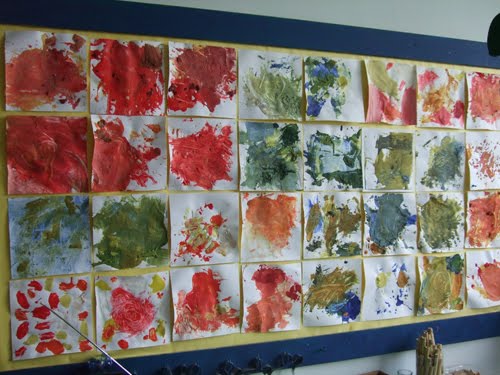
Pictures in the Play English atelier (Art Studio), May 2009


My visit to Play English was part of a two-year exchange programme the school had with the Eureka! Nursery. The Play English ethos draws heavily on the HighScope and Reggio Emelia philosophies. While I understood the philosophy, I wasn’t clear how the two approaches and the Early Years Foundation Stage would work together. That was where Play English came to my aid. Play English promotes a mode of learning that allows the child the freedom and independence to discover their own types of learning within a structured theme. Giving children this independence and the choice to learn in a comfortable and familiar manner has been seen to increase their confidence and improve life long learning.

‘Play English’ have a full time Art Specialist called the ‘Atelierista’, who works with small groups of children both in the classroom and in the art studio called the ‘Atelier’ where she develops and extends the children’s creativity as a language of expression. I spent time with the schools ‘Atelierista’ observing her sessions with children, her planning and had the opportunity to discuss her philosophies.

Working with the ‘Atelierista’ I discovered that children can have freedom of self discovery within a themed programme. I used this knowledge to design a programme for the Eureka! Nursery children. It was a huge success and inspired me to roll it out to a larger audience, so I developed the idea into this year’s Early Years Week programme ‘Light & Shadow’. 

Light & Shadow allows children to explore the world of 2 and 3 dimensional objects and to see how light affects the world around them, developing their curiosity of cause and effect. During the week children will have the opportunity to explore with torches in the dark crevices of the Desert Discovery Gallery; there will be large sheets with images and shadows projected on them in various places in the museum. Children will be able to look at their own shadows created through natural light on the balcony and much, much more. With the use of both natural and artificial light they can discover the effects created and by using their own investigation techniques they can explore form, colour, density, pattern and shape, through both natural and artificial objects.

One important aspect that I took with me from my experience, is the way to help children with their own personal development through investigation, experiment, and problem solving. I believe that the concept of child-led play with open ended outcomes is essential to the personal learning development of children.

It is this freedom to let children be creative without set directions and instructions that allows the development of independence, control, confidence, and the ability to learn by their own mistakes and successes

Penny Dargan is an Early Years Specialist Enabler at Eureka!