Thursday, 7 April 2011

Making mealtime count in the Nursery

At the Eureka! Nursery, a child’s whole day is about learning through play. Meal times are no exception, where the pre-school children really develop with the positive approach we take to include them in meal times.  We have done some really exciting mealtimes for the children, to introduce them to new foods or experiences. An example of this was with the World Cup, where every day they had a new food from a different country. There was everything from South African ‘bobotie’, to Brazilian ‘feijoada’ and of course good old bangers and mash when England played!
Eating for England during the World Cup!
However, learning isn’t just about new and novel experiences, although they’re really fun for all of us. We learn a lot through every day experiences, and at the Nursery we work hard to make sure that there are plenty of opportunities, from assisting setting places for dinner to learning to eat with a knife and fork—however messy that might be.

Each day in the Nursery, children take turns being the day’s superstar. With their ‘key person’ (a member of staff who has responsibility for monitoring the child’s development and providing them with in-depth personal support), they help to assemble the meals delivered from the Eureka! CafĂ©, lay tables and serve both meals and snacks. Today, it was Freya’s turn. She told me ‘I’m helping to give dinner out today, I’m the superstar’.

The other children are still involved too. Sam was waiting patiently for his dinner, but he still let Freya know ‘We need two more dinners over here please!’ Through these activities, they’re continually developing their personal, social and emotional skills and it’s a great confidence booster as children are so excited about having a role to play. Sam did a great job of demonstrating how these activities help children take ownership: not only was he applying knowledge by calculating how many dinners were left to serve, but he also had the confidence and self-esteem to articulate this to Freya and her key person.

Tea on this particular day was sandwiches. Another positive of having all of our children eat together and get involved in the mealtime process is they’re able to become more aware of each other, through speaking and sharing, and by learning to identify differences. Understanding dietary differences, due to allergies or cultural and religious beliefs is another key outcome for our children. Sam and Kai were putting together their sandwiches, and as Sam put a slice of ham on his bread he looked at Kai and said: ‘You have to have cheese Kai, cause you’re vegetarian, aren’t you?’

Having your child involved in food preparation gives them ownership and encourages independence
They’re also aware of healthy eating practices—something very important these days! Oliver was quick to point this out, telling Molly: ‘You have to eat your carrots Molly, because you want to get big and strong, like my daddy! And my daddy goes to the gym too’. What was really lovely was that it was Oliver and his friend Molly having a conversation. He wasn’t ‘telling’ her, he was sharing the knowledge he’s gained at home and in the nursery.

There’s so much to learn from a simple meal time, as we know very well here at the Nursery. For us though, one of the most important reasons for getting the children involved with dinner is that they’re having the chance to take pleasure in who they are and what they can do. They’re learning about their identity and abilities, and that in turn helps them in how they share and learn with others.

Meal times are a great way to get involved with your child’s learning. Here are a few easy things you can do at home!

  • Learn more about different cultures through your meals. Even something as simple as having a Chinese takeaway and eating with chopsticks can introduce new ways of eating. 
  • Let your child help with meal preparation, and eat with cutlery just like the grown ups. Not only do they have ownership in what they’re eating, but any opportunities to develop complex physical skills (like those used for grating, chopping and peeling). 
  • The table settings might not be perfect, but setting out the dishes and spoons develops understanding of maths, and helps with spatial awareness.Ask questions and encourage a discussion at dinner. 
  • When you’ve just learned something, you want to share it… and a child is no different! Linking experiences helps children to develop a positive sense of community and expand their vocabulary.

Do you have any ways that you get your child learning at mealtimes? What works well for you?

Clare Dean is an Early Years Professional in the Eureka! Nursery.

Friday, 1 April 2011

Joining the Play Revolution

A common misconception about Eureka! is that we are a commercial visitor attraction …many people simply don’t know we are a non-profit charity.  This is something we hope to tackle in the coming months, as we give you, our visitors, a lot more information about the work we do in the museum and beyond in our outreach programmes.

As an educational charity we receive no government funding. Our museum and activities are funded by our admission fees, fundraising and commercial activities like our shop and cafe. Therefore, every single voluntary donation makes an incredible difference.

Our next major project is the development of our new flagship exhibition Me and My World.  This will replace the much loved Me and My Body gallery, but don’t worry – we will make sure we retain and update some of your favourite exhibits!  The new exhibition will cost a grand total of £2.9m of which we have already raised £2.1m, so we are well on our way to reaching this total but there is still a lot of work to do.

As one of the thousands of people that read our blog every year, we hope you can do one simple thing to help out.  Quite simply, we need 5 minutes of your time.  Eureka! has registered on the Co-operative Revolution campaign where you can vote for your favourite revolution.  Eureka! of course is leading the play revolution so simply follow the link provided and register your vote.  The most popular revolution in each region will be awarded £5,000 and if all our readers take a few minutes to do this, we’re in with a good chance! 

It won’t cost you a penny, and will help us achieve our vision of an exhibition which will inspire a whole new group of children who, like their parents before them, will look back on days spent at Eureka! as some of the most magical learning moments of their childhood.

You can register and vote online on the Co-operative Revolution website.

Kate Goldring is the Fundraising Manager at Eureka! The National Children's Museum.

Thursday, 24 March 2011

Serious play

I could begin this blog by saying: ‘Here at Eureka we take training our staff very seriously’, because we do. But ‘serious’ suggests lectures, assessments, boredom and other things that are, well, serious! This was certainly not the case when it came to our ‘It’s Up To You’ training this month. Creative, spontaneous and hilarious are more like it.

Creative staff training helps inspire our Enablers when delivering programmes.
We were training our staff for something called the ‘It’s Up To You’ Hour. The idea was trialled last year and gave our Enablers a whole hour during the day in which they could do whatever they liked; tell a story, run a juggling workshop, take musical instruments into the galleries or other things of that nature. We found that our staff had many hidden talents which emerged through this initiative and the ‘Its Up To You Hour’ generated some of the best customer feedback we received in years. So we decided to re-launch the idea this year, timed with the hiring of a whole new batch of Enablers.

For the training we collected a vast number of resources; costumes, storybooks, props, and other diverse items. We then put the Enablers into groups and gave them the freedom to devise a full days worth of events using what we had in the room or anything they could find from the museum.

Complete freedom, however, can be intimidating, so we gave each group a simple scenario detailing how many visitors were in the museum and what the weather was like on the day they were planning for. This helped to inspire some of the events and made the enablers think about whether a particular event is suitable for varying visitor numbers.

‘We all need empty hours in our lives or we will have no time to create or dream’

The quote from child psychiatrist and author Robert Coles sums up or philosophy when executing the session. Creating a stimulating environment where the staff felt free to do what they wanted worked far better than having a structured training schedule as it gave them room to ‘Create and Dream’, though our hours were far from empty.

There was no shortage of ideas; staff devised a range of different activities, from manic games involving water balloons to quiet and calm origami folding. In this setting the Enablers were empowered to show off their many talents as musicians, magicians or historians.

Fun was had by all and this fun atmosphere will be directly passed onto our visitors who can expect varied spontaneous events and activities in our galleries in the future (particularly on weekends and quiet afternoons)!

So as we see training is a very important part of being an Enabler at Eureka, but I still wouldn’t say that ‘At Eureka we take training our staff very seriously’; I would rather say that ‘At Eureka we take training our staff very playfully’.

Ben Healey is a Team Leader at Eureka! The National Children's Museum

Thursday, 10 March 2011

Over the rainbow with Early Years activities

Half terms at Eureka! are fantastically themed filled events and this latest one was no exception. Our theme for this particular February half term was the classic film ‘The Wizard of Oz’; the influence of which resonated throughout the full museum. As the Early Years enabler it was my job to make sure that this was also key feature of the under-fives’ area, the Creativity Space. So when it came to deciding on what aspect of the Wizard of Oz to concentrate on I began by breaking the story down to its basic components and found the amazing array of colour featured within. I found that I was also fascinated by the colour used in the film and how they highlighted this burst of colour by beginning with black and white film and then over the rainbow to the wonderfully highlighted, technicolour Land of Oz.

Ready for rainbows in the classroom, as one of our Enablers plays with the light box.
As an Early Year professional I know that colour is greatly important early on in the Early Years Foundation Stage and that, by the age of 3, some children will be able to identify and match up colours. Researchers have found that toddlers are able to learn the names of colours but not an understanding of the relationship between the colours. By the time children are three years old they have mastered the basic colours and correlations between them. However, at this age colourations, shades and neighbouring colours are often still confusing and mistakes are easily made. As learning about colours can be lots of fun I took this as a fantastic opportunity to enhance the opportunities for learning about colours at Eureka! and to express the importance of colour with our ‘over the rainbow’ focus.

Whether we realise it or not colour plays such an integral part of our lives. As babies we begin to associate colours to moods and feelings and throughout our childhood we build upon this. Pink is often associated with a comforting feeling as this is the colour we might have experienced whilst in the womb. Even when we grow older we can attribute other emotional connotations to colours.

Colour is everywhere; all around us this magnificent planet contains all the colours of the rainbow. When we break colour down into it’s simplest form colour is simply light interacting with receptors in our eyes to ‘show’ us the primary colour spectrum: red, orange, yellow, green, blue, indigo and violet; the true rainbow. For The Wizard of Oz our little ‘munchkins’ experienced a different colour each day of the week in accordance to this true rainbow. Within the classroom there was colour everywhere! The light box had coloured sand. The . water tray held coloured gooey ‘Gelli baff’, which is a product that turns children’s bath water into jelly like goo and then back again. The children could paper mache a section of the rainbow, and were also able to choose from an array of materials to create their own masterpieces; all of these were changed daily in accordance with the colour of the day. Along with each colour of the day I also featured their shades of colours, such as light and dark and pastel and vivid colours in order to highlight that each colour is not singular but has an array of variations across the colour wheel.  

It was fantastic to see the children respond in such a positive way to this theme and to the colours within the Creativity Space. I even noticed the impact of some colour days over others; ;on the red and yellow days where people seemed more vivacious than on the more subdued green and blue days. Whatever the reasons for this we all had a wonderful time; this was a well received event and I loved every minute of the week.

During the week, I particularly enjoyed the day where I worked with my favourite colour, blue. What’s your favourite colour? What do you like about it?

Penny Dargan-Makin is the Early Years Specialist Enabler at Eureka! The National Children’s Museum.

Thursday, 17 February 2011

Making ‘cents’ of Money Matters

Our new workshop started this week. It’s called ‘Money Matters’ and is very topical when you consider the recent calls for financial education to be made compulsory in schools. Here are a few facts, taken from the Personal Finance Education Group website, that point towards why starting financial education young is important.

•    7 years is the average for children to begin receiving pocket money.
•    8 years is the average age for UK children to get their first mobile phone.
•    10 years is the average age that children begin to purchase items online.

And…

•    Over 75% of 7-11 year olds are already saving for the future.
•    42% of children prefer to store their money in a money box.
•    93% of teachers and parents think that personal finance education should be taught in schools.

So, we think we’re on the right track. As Billy Graham once said: ‘If a person gets his attitude toward money straight, it will help straighten out almost every other area in his life’.

The Money Matters workshop takes place in the Eureka! Bank and our ‘Imagination Space’ room and involves: exploration, investigation, discussions, games and (of course!) role-play. It will hopefully help develop in the children a good attitude towards saving and financial responsibility.

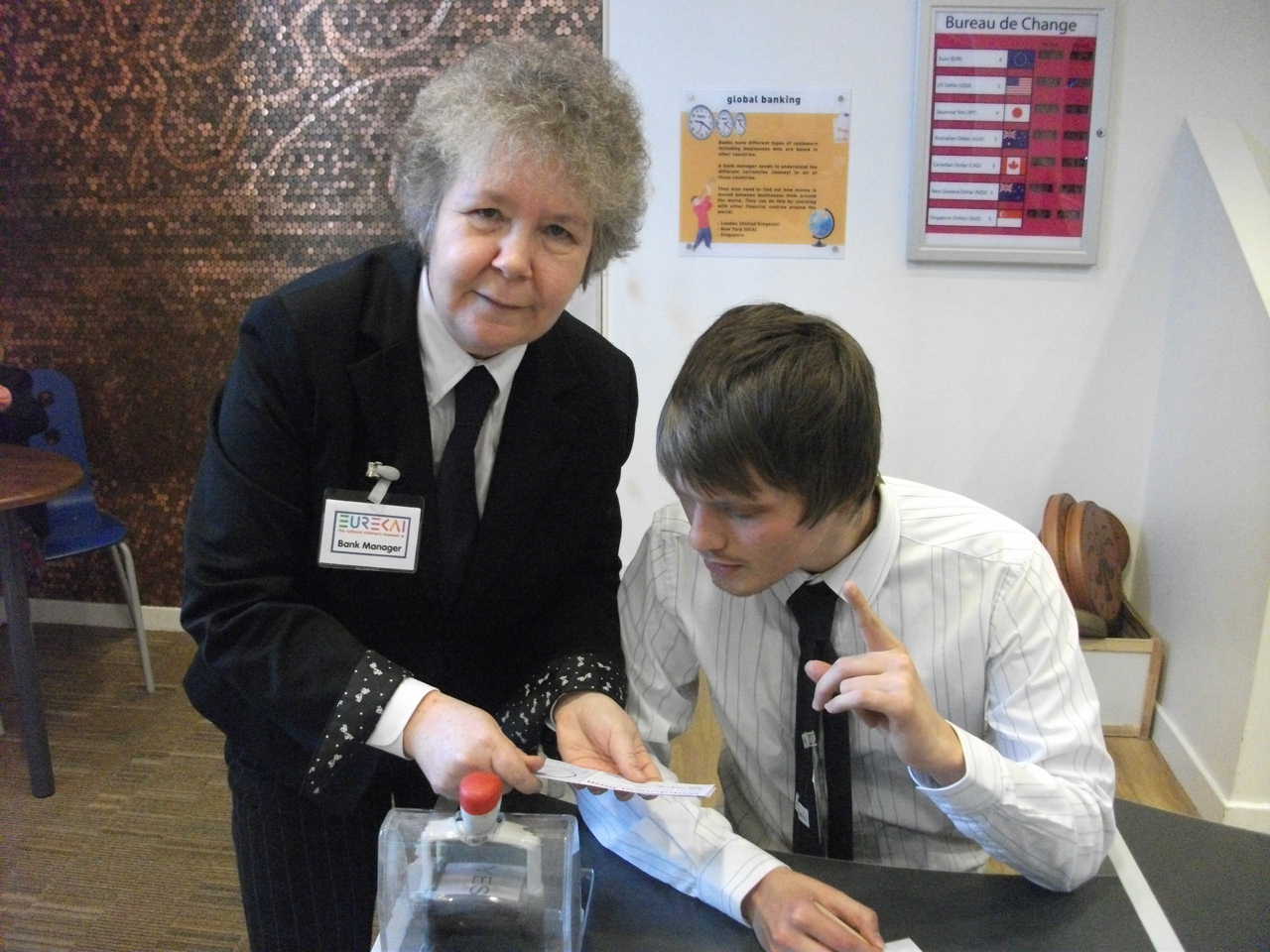
On one particular morning last month, I was dressed very smartly in shirt, tie and jacket with my ‘Bank Manager’ badge hung from my lapel. Enabler Darren was my cashier and also looked the part in another smart shirt, tie and badge. We had great fun in the bank as the children (7-9 years old) filled in withdrawal forms with Darren to get their Eureka! Bank notes and phoned me in my office to ask pertinent questions such as ‘Why should I keep my money in your bank?’ and ‘Is it fun being a bank manager?’

Money matters here in the Eureka! Bank!
They explored the bank vault with its huge thick doors and different alarm systems. They discovered all the security features that make it so difficult to forge a banknote. They even sat in a million pound chair and contemplated what they would do if they had that much money!


Keeping the Bank Vault safe and secure!
Back in the Imagination Space we had the children counting up giant laminated coins, working out interest payments on their calculators and joining in with a game that was a mixture of  ‘Play Your Cards Right’ and ‘The Price is Right’. The children responded brilliantly to the tasks and the discussions. It was heartening to hear their reasons for not spending all their money:
•    “Because you won’t be able to keep your promises if you’ve promised to take somebody on a day out”
•    “Because you won’t be able to buy your mum a birthday present”.

They were also very enthusiastic about giving their money away to charities:
•    “Because it’s good to help other people who are poor”

By the end of the workshop the class had accrued over £400 in Eureka! Banknotes. We sent them home with the task of deciding as a class how they would spend, save and give away that money if it were real. It’s a great way to make sure the lessons of saving and spending wisely continue after their visit to Eureka! and I look forward to hearing from them and finding out what they decide.

Jill Ward is an Enabler at Eureka! The National Children’s Museum. If she received £400 she would:
•    Treat herelf to a couple of DVDs.
•    Treat her family to a nice meal out.
•    Give £50 to Comic Relief (because that’s her favourite charity).
•    Save the rest of it towards her next holiday.

Thursday, 10 February 2011

Hello Halicat!

At the Eureka! Nursery last week there were lots of excited children in our pre-school waiting for a very special visitor: Halicat!

A little background, since the mascot from the Halifax Rugby League Football Club doesn’t stop by Eureka! every day. Following the lead from the children’s interest in colours the nursery’s preschoolers have been choosing a colour a week. We have been encouraging the children to bring in objects from home for their show and tell sessions. Last week was blue, and one of the children, Alex, decided he wanted to bring Halicat, who wears a blue and white striped shirt. Alex’s mum works at the Halifax RLFC, and between her office and our nursery we knew there was no question: how could we not make it happen?

Alex brought many Halifax RL artifacts during the week, leading up to the main event and on the Friday morning it was announced that Halicat was coming. We discussed it with the children to prepare them for the visitor. The children were excited, but also concerned about how Halicat would be able to come into the nursery and be safe. Together we all carried out a risk assessment for Halicat. The questions included:
  • How will he know where he’s going?
  • Will he get wet in the rain?
  • If he is so big, what if he doesn’t fit through the door?
We went through all of their questions and assured them that everything would be just right for Halicat’s visit. Just in case, one of the children, Oliver, decided to make sure that a big umbrella was ready at the door for Sandra, our Head of Nursery, to carry out to Halicat if it started raining.

Although the children knew Halicat would come after their dinners they were continuously checking my watch to see if the little hand was at one and the big hand at six. Sam asked me if they could use key worker group time to make presents for Halicat. I thought this was a fantastic idea because it would help them develop colour awareness and give the children ownership of the project. The children wanted to make blue and white scarves, headbands and bracelets, using their colour awareness effectively as they made links between their artworks and the Halifax rugby team’s colours. Everyone had a different way of making their decorations; some made white and blue stripes with rollers, some did finger printing, hand printing, there were so many excellent techniques to try that before we knew it, their dinner was ready.

The dinner period turned into a conversation about what Halicat might eat. Lucas thought chips and Sam thought cat food. After lunch, we sat down on the carpet. The children had put on their scarves and garments; at this point they were so proud of what they had made, they were no longer presents for Halicat, but something for them to show to him what they had achieved. When the security buzzer rang at the Nursery’s front door, Oliver made sure I carried out the safety checks, and all of the children were jumping with excitement.

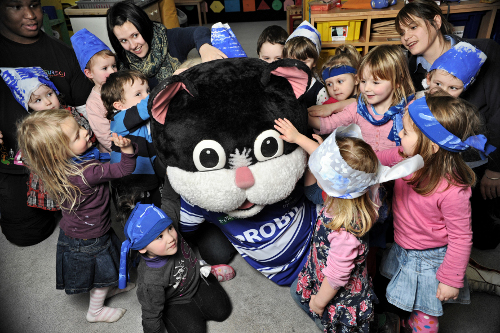
Children playing with Halicat
It was funny how quiet and nervous the room become when Halicat walked in, but the shy silence was quickly broken by Lucas, who asked ‘Are you Halicat?’, and Halicat nodded.

The questions came on strong after that, and from Alex’s mum they learned that Halicat lives in Shay Stadium, and comes out when the rugby team are playing. This was a good cue for us to encourage the children to communicate about their experiences and family members. Thea said her dad plays rugby, Oliver said his dad was ‘really strong’ and Sam told us he had been downloading photos of Halicat to his dad’s mobile phone!
Halicat prompted another positive learning experience for Ruby. She asked if she could bring out her cat, a very special toy who goes everywhere with her. Ruby came back with her cat and explained confidently to Halicat and the entire group why her cat is different and the same. She told us about the differences in colour; hers is pink, but they both have black whiskers. She identified the size difference, and that Halicat had on big boots and her cat did not.

After a lot of discussion and cuddles, Halicat gave hi-fives to everyone and they all posed for a photo. He even did a little dance before returning home to Shay Stadium.

Posing for the camera.
 The fun, holistic learning experience is still ongoing. The children have regularly revisited their photos of Halicat, and dress up with the different accessories they made. I often hear interesting conversation too as they play together, ‘put your scarf on, it’s rugby today’. What used to be a Chinese dragon has now been made into a ‘Hali-dragon’ by wrapping blue and white material around its head, on suggestion from the preschoolers.

Some children are now saying they will visit Halicat regularly on match days, which is exciting because it could be a new experience for the whole family. For those who aren’t going their not missing out, as Alex will give a regular update for us all. As he said: ‘I see him on Sundays, he’s my best friend!’

Clare Dean is an Early Years Professional at the Eureka! Nursery

Thursday, 3 February 2011

An exciting start to 2011

2011 has started here at Eureka!, and if the past month if anything to go by it's going to be a busy year.

We started the year with Wallace and Gromit Invention Sessions as part of our Winter 2011 Ingenious Inventions activities, and with a month to go it seems like our visitors are as excited about the sessions as we are.

Our new 2011 leaflets arrived. Have you seen them yet? We love the bright yellow colour, but more importantly, pick one up on your next visit so you know all about the big events for 2011.

In January we also officially launched a new exhibit, the Hydrogen Fuel Pump and the hydrogen fuel powered car in the Garage in the Living and Working Together gallery. The exhibit was supported by Air Products, who brought HydroJen, the hydrogen power ambassador to the launch. The Mayor of Halifax, representatives from Air Products and Eureka! and children on a school visit were all on hand for the launch.

HydroJen and children with the Hydrogen Fuel Pump

Although it wasn't a Eureka! event, we also hosted the Northern Rail Cup launch for Rugby League Football here at the museum in January. On a week day in January it is usually quiet in the museum, so it was quite exciting to have so many rugby players, coaches and journalists in and around Eureka!.

Now that February is here, we're in full swing getting ready for half-term. Some of our Enablers have been hard at work on the Emerald City Challenge, a Wizard of Oz themed obstacle course in the Eureka! Theatre that will be on during half-term. Others are hard at work practicing the different science tricks they'll be showing off around the museum, or getting ready to go into character as Dorothy, the Cowardly Lion, the Tin Man and the Scarecrow.

February half term at Eureka! runs from Monday 21 - Friday 25 February when we are open from 10am - 5pm. Since many schools are getting out at different times this month, we are also open on Monday 14, 21 and 28 February, if you want to get playing!

Don't forget that the Wallace and Gromit Invention Sessions will be running every weekend until 28 February. If you have children over the age of 7, this is a great chance to get a hands-on mechanical project that the whole family can do together, using the exclusive kits inspired by the BBC series Wallace and Gromit's World of Invention and created by Aardman Animation!

Have you been out for an Invention Session or had a play with the hydrogen fuel pump yet?